Skip to content
The part of the process nobody writes down
What Nobody ExplainsThe part of the process nobody writes down

Queues & Waiting

Why one line feeding many counters beats a line at each counter

The single queue is not merely fairer; it is measurably steadier, and the reason is variance rather than courtesy.

By Amrita Kohli4 min read

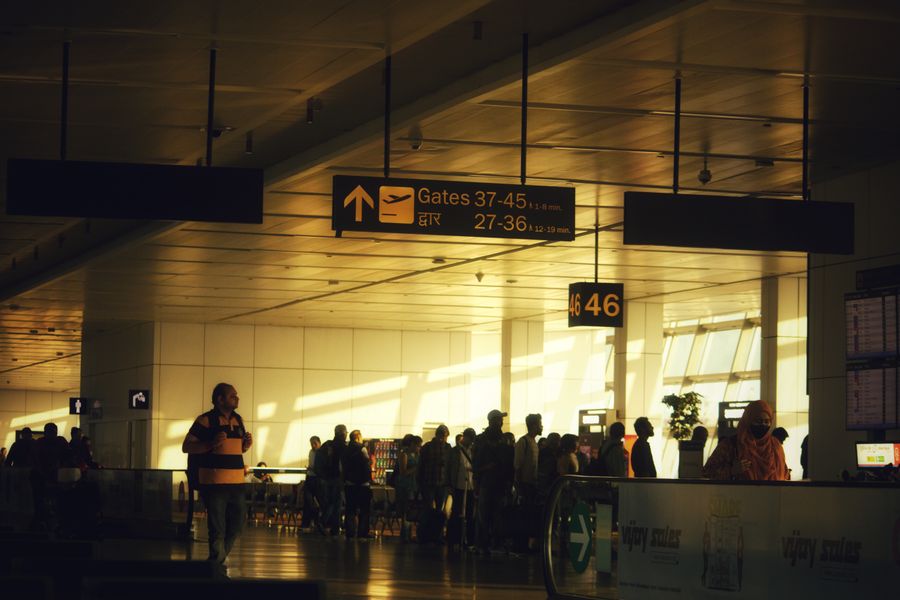
Crowded hallways and directional signs guide travelers in Delhi Airport.
Photograph by Omkar Pendsay via Pexels
Editorial note. Independent reporting and analysis. Nothing here is sponsored or paid for. How we work.

The same servers, a very different wait

Put five counters behind five separate lines and you have one arrangement. Put the same five counters behind one line that feeds whichever position frees up next and you have another. The number of staff is identical, the amount of work is identical, and the average wait across everybody is very nearly identical too.

What changes is the spread. In the single line almost everyone waits close to the average. In parallel lines a good number of people wait far less and a good number wait far more, entirely according to which line they happened to choose. That difference in spread is the whole argument, and it explains why so many places that resisted the single line for years eventually adopted it.

Where the variance comes from

Service times are not uniform. Most transactions are short and a few are very long, and there is no reliable way to tell which is which by looking at the person. A queue is therefore a sequence of mostly small numbers with an occasional large one buried somewhere inside it.

In parallel lines, one long transaction blocks everybody standing behind it and nobody else. The cost lands entirely on the people who guessed wrong, and it lands heavily. In a single line the same long transaction occupies one position while the other four keep drawing from the front, so its cost is spread thinly across everyone rather than dropped on six unlucky people. Nothing has been made faster. The distribution of the same delay has simply been evened out.

The idle counter problem

Parallel lines have a second and less obvious failure. It is entirely possible for one position to stand empty while people are still waiting elsewhere, because those people committed to a different line and have not noticed or cannot easily move. Capacity sits unused while demand sits unserved.

A single line makes that impossible by construction. A free position is filled by the next person, always, and the system therefore uses everything it has at all times. This is why the arrangement improves throughput slightly as well as fairness, though the throughput gain is smaller than people expect and the fairness gain is larger.

Jockeying costs more than it looks

When people can see multiple lines, they compare them, and some switch. Switching produces its own losses: the gap left behind is not always filled promptly, the switcher rejoins at the back of somewhere else, and the constant assessment turns waiting into a low-grade decision task rather than a pause.

It also produces the most reliably infuriating experience in queueing, which is choosing badly and watching the line you left move first. A single line removes the choice and with it the regret. Some of the satisfaction people report is not about speed at all; it is about no longer being responsible for the outcome.

What the single line costs

It is not free. One long line looks worse than five short ones even when it is faster, and a queue that looks long deters people from joining it — which matters a great deal in retail and rather less at a service counter people cannot avoid. Space is the other constraint, because a single line needs somewhere to fold, and not every floor plan has room.

There is a third cost that is easy to miss. Parallel lines let you choose a specific person, which is useful when transactions differ in kind or when someone knows your case. A single line makes everybody interchangeable, which is efficient and occasionally exactly wrong.

Why hybrids keep appearing

The compromises are visible everywhere once you look. A single line for general service with a dedicated position for one class of transaction, because separating the long jobs out protects the short ones. An express lane defined by quantity rather than by task. A number-ticket system, which is a single line that has been allowed to sit down.

Each of these is trading the same three things against each other: fairness, throughput and the way the wait appears to somebody deciding whether to join it. There is no arrangement that maximises all three, which is why the answer differs between a bank hall, a supermarket and an airport, and why an arrangement that looks obviously wrong is sometimes solving a constraint that is not visible from where you are standing.

The one arrangement that is hard to defend on any of the three counts is parallel lines with no way to move between them and no visibility of how long each will take. That combination gives you the variance of parallel queues, the powerlessness of a single one, and the resentment of both. It survives mainly where the layout was fixed before anyone thought about the queue, which is more places than you would hope.

Common questions

Is a single queue actually faster overall?

Slightly, because no counter sits idle while people are still waiting. The larger effect is on consistency rather than speed: the average wait barely moves, but the chance of an unusually long wait falls sharply.

Why do supermarkets still use parallel lines?

Partly space and partly appearance, since a single long line reads as a deterrent to somebody deciding whether to shop at all. Trolley volumes also make a folded single queue physically awkward in a way it is not at a counter.

Do ticket systems work the same way?

Structurally yes, since a numbered ticket is a single queue with the standing removed. The trade is that people lose the visual sense of progress that a moving line provides, which is why displays showing the current number are not decoration but a necessary substitute.

Queues & Waitingqueueswaitingdesignservice
Amrita Kohli
Contributing editor, What Nobody Explains

Amrita has been reporting on behind the counter, paperwork, queues & waiting since long before it was fashionable and thinks most subjects are more interesting once you know how they work.