Skip to content
The part of the process nobody writes down
What Nobody ExplainsThe part of the process nobody writes down

Queues & Waiting

What the rope maze is for, and what a virtual queue changes

The physical shape of a line and the decision to let you wait somewhere else are two separate design choices, each with its own trade.

By Anjali Raghunathan3 min read

Multi-ethnic group standing behind orange and white barricade tape on a white background.
Photograph by Pavel Danilyuk via Pexels
Editorial note. Independent reporting and analysis. Nothing here is sponsored or paid for. How we work.

A serpentine solves a floor-space problem first

The folded line inside barriers is usually explained as a psychological device, and its first job is geometric. A queue of a hundred people is a very long object, and folding it into a compact rectangle is the only way to fit that object into a hall without it reaching the doors or blocking a corridor. Everything else the arrangement does is secondary to that.

The barriers do a second physical job by defining the line unambiguously. An unmarked queue in an open space has fuzzy edges, and fuzzy edges are where disputes begin: whether somebody is queuing or standing, whether a line turned left or right at the pillar, where a group ends. A rope removes the ambiguity, and most of what is described as good queue behaviour is really the absence of anything to argue about.

The fold changes what the wait looks like

A folded line also alters perception, and the effects are reasonably well established among people who design these spaces. A hundred people stretched into a single straight line looks hopeless; the same hundred folded into six ranks looks manageable, because the visible dimension is now the width of the block rather than the length of the queue.

Movement is the other half of it. In a serpentine the front of the line is close by and its progress is continuously visible, so the queue reads as active even when each individual step is small. A straight line disappearing round a corner offers neither reassurance. The wait is identical; what changes is how much evidence you have that it is a wait rather than a stall.

Where the barriers are actually deciding something

The genuinely consequential decisions are about entry and exit points. A single entrance makes the join point obvious and joining out of turn socially impossible. Gaps in the barrier for accessibility or for staff movement are necessary and create ambiguity precisely where the line is least able to resolve it.

The exit is the harder problem. A queue feeding several positions needs a mechanism to tell the person at the front which position is free, and where that mechanism is weak the queue develops a hesitant, stuttering front while everyone tries to work it out by watching. A screen, a light or a person calling forward isn’t decoration; it is the part of the design that determines whether the servers are ever idle while someone waits three metres away.

A virtual queue moves the waiting without shortening it

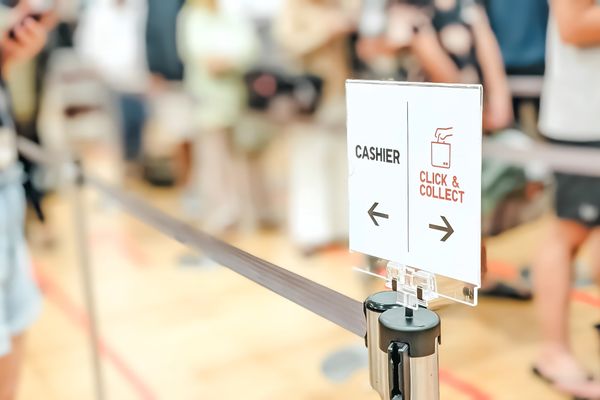
Taking a number, or joining from a phone and being called back, changes where you wait rather than how long. The place in line is preserved abstractly while your body goes elsewhere, which is genuinely valuable: waiting is far more tolerable while sitting, eating or doing something else than while standing on a marked floor tile.

It also decouples the size of the queue from the size of the room, which is why the arrangement spread so quickly. A hall that can physically hold sixty people can run a queue of four hundred if the queue exists in a database. That is a real gain in capacity and comfort, and it isn’t a gain in throughput. The same number of positions serve the same number of people per hour either way.

What the virtual version takes away

The losses are specific. A physical line is self-evidencing: you can see how many are ahead, watch the rate, and estimate. A virtual queue replaces that with whatever information the operator chooses to publish, and the estimate is now a claim rather than an observation. Trust becomes necessary where previously it was unnecessary.

There is also a return cost. Being called back requires being reachable and within range, which imposes a constraint that standing in a line does not, and missing a call usually has consequences defined by a rule you did not see. And the queue becomes invisible to the people managing the space, so a room that looks calm can be badly over-committed, which is why the pace of a virtual system sometimes changes for no visible reason.

Reading a waiting space

The useful signals are structural rather than atmospheric. How many positions are actually staffed, as opposed to how many exist. Whether the mechanism calling people forward is working smoothly or leaving positions idle. Whether the queue you can see is the whole queue or only the visible portion of a virtual one.

That last question is the one worth asking directly in any hall with a ticket machine, because the length of the line in front of you may bear no relationship at all to the number of people ahead of you.

Common questions

Is a folded queue actually faster than a straight one?

No. The shape does not change how quickly people are served; it changes how much floor space the line occupies and how the wait is perceived. Throughput is set by the number of staffed positions and the time each transaction takes.

Why do some ticket systems feel slower than standing in line?

Partly because the information changes character: in a physical line you can observe progress directly, while a ticket system gives you only what the display chooses to show. The wait may be identical, but an unobservable wait is consistently experienced as a worse one.

What happens if I miss my callback or my number?

It depends entirely on local rules, which are usually posted somewhere near the machine and rarely read. Some systems reinstate a missed number after a short interval, some place it at the back, and some require a new ticket, so it is worth checking before leaving the area.

Queues & Waitingqueuesdesignvirtual queueswaiting
Anjali Raghunathan
Deputy editor, What Nobody Explains

Anjali joined to cover behind the counter, paperwork, queues & waiting and stayed for the awkward questions and reads the small print so you do not have to.