Skip to content
The part of the process nobody writes down
What Nobody ExplainsThe part of the process nobody writes down

Paperwork

What the box marked “for office use only” is doing

The section you are told to leave blank is where the form stops being a question and starts being a work record.

By Lukas Brenner3 min read

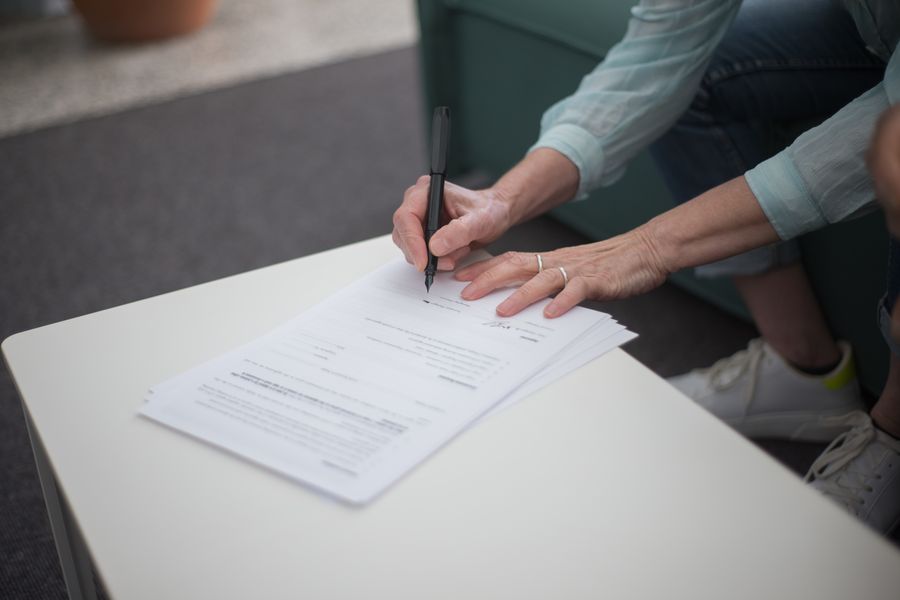
A person signing important legal documents on a table, emphasizing business and professionalism.
Photograph by Kampus Production via Pexels
Editorial note. Independent reporting and analysis. Nothing here is sponsored or paid for. How we work.

The form has two halves and only one of them is yours

Most official forms carry a section, usually boxed off and often shaded, that instructs you not to write in it. People generally read this as an internal detail of no interest. It is the more revealing half of the document, because it shows what the organisation intends to do with what you have written.

Your half of the form is a questionnaire. The office half is a work record: a small, standardised place to capture who handled the form, when, what was checked, what was decided and where it went next. Read together they describe an entire process rather than a request.

Most of those boxes are checkpoints made visible

The commonest contents are a date of receipt, initials, a set of tick boxes and a reference. Each tick corresponds to a check somebody was required to perform: identity seen, documents matched, calculation verified, signature present. The box exists so that the check leaves a mark, and the mark is what makes it possible to establish afterwards that the step happened at all.

This is why a form can be returned for a reason that has nothing to do with your answers. If a checker cannot complete their part — because a required enclosure is absent, or because two of your answers cannot both be true — the form cannot progress, and the tidiest way to explain that is to send it back with the relevant part flagged.

Routing marks decide where the paper goes next

A second family of marks handles movement. A code identifying which team should receive the form, a category or scheme reference, a batch number, sometimes a simple priority indicator. These are written at intake, and they determine the queue the form joins, which in practice determines how long everything after that will take.

It is worth noticing that the routing decision is made from the front page, usually in seconds, by somebody who has not read the whole form. That is the strongest practical argument for making the first page unambiguous: the reference in the right place, the scheme or category stated plainly, and any covering explanation attached where it will be seen rather than buried at the back.

The date stamp in that box is the date that counts

When something arrived is a fact with consequences, and the office section is where that fact is recorded. The date entered there — typically the date of receipt at the point of intake rather than the date you wrote at the top — is what deadlines, entitlements and sequencing will later be measured against.

The gap between the two dates is usually small and occasionally is not, particularly around collection times, weekends and busy periods. It is one of the better reasons to obtain a receipt or an acknowledgement when handing something over in person, because it gives you a record of the same event from your side, timed independently of the one written in a box you were told not to touch.

Why you are asked to leave it alone

The instruction isn’t ceremonial. Marks in that section are treated as having been made by staff, so anything written there by an applicant corrupts a record that other people will rely on. In forms processed by scanning, the office boxes are also read by software configured to expect particular marks in particular positions, and an unexpected stray line produces a rejected image rather than a helpful one.

There is a milder version of the same problem across the rest of the page. Notes written in the margin, arrows to a comment at the bottom, corrections made with a line through and an insertion above — all of these are perfectly readable to a person and invisible or actively disruptive to a scanner. Where a form supplies an additional information box, that box is the place the extra material will actually be captured from.

Reading the office section for what it tells you

When a form comes back, the office section is often the fastest explanation of why. A ticked or annotated line usually identifies the failed check directly, which is often more precise than the covering letter’s summary and considerably quicker to read.

It is equally useful before submission. Looking at what the office half asks the checker to confirm tells you exactly what the form is being examined for, and it is a far better guide to getting a submission through first time than reading the guidance notes from the beginning. If the checker is required to confirm three enclosures and a signature, then three enclosures and a signature are what the whole exercise turns on.

Common questions

What happens if I accidentally write in that section?

Usually very little beyond an annoyance, though it may be crossed through and initialled so the record stays clear about who wrote what. On forms read by scanning equipment the risk is higher, because unexpected marks in a defined area can cause the page to be rejected for manual handling.

Is the date in the office box the date I sent it?

No, it is normally the date of receipt at the intake point, which can be later. If timing matters, keep independent evidence of when you sent or handed it over, such as a receipt or a proof of posting.

Why does the same form have different office boxes in different places?

Because the office section is tailored to the process handling that form, and processes vary by scheme, by department and over time. It is also the part of a form most often revised, since it changes whenever the internal workflow changes even if the questions do not.

Paperworkformsprocessingintakeprocess
Lukas Brenner
Features writer, What Nobody Explains

Lukas has written about behind the counter, paperwork, queues & waiting for most of the last decade and thinks most subjects are more interesting once you know how they work.