Skip to content
The part of the process nobody writes down
What Nobody ExplainsThe part of the process nobody writes down

Queues & Waiting

Why a service running at full capacity always has a queue

Waiting time does not rise smoothly as a service gets busier; it rises gently for a long while and then very sharply, and the shape of that curve explains most staffing decisions.

By Zoya Rahman3 min read

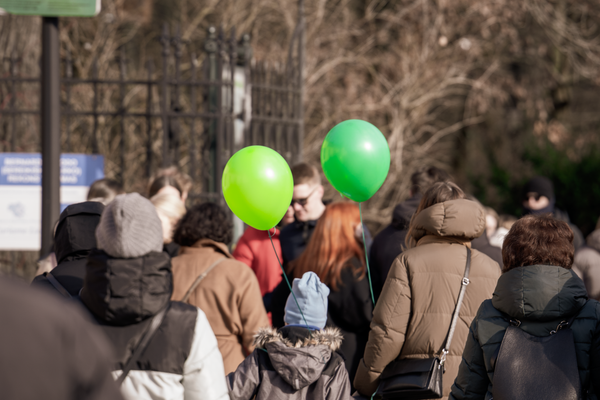
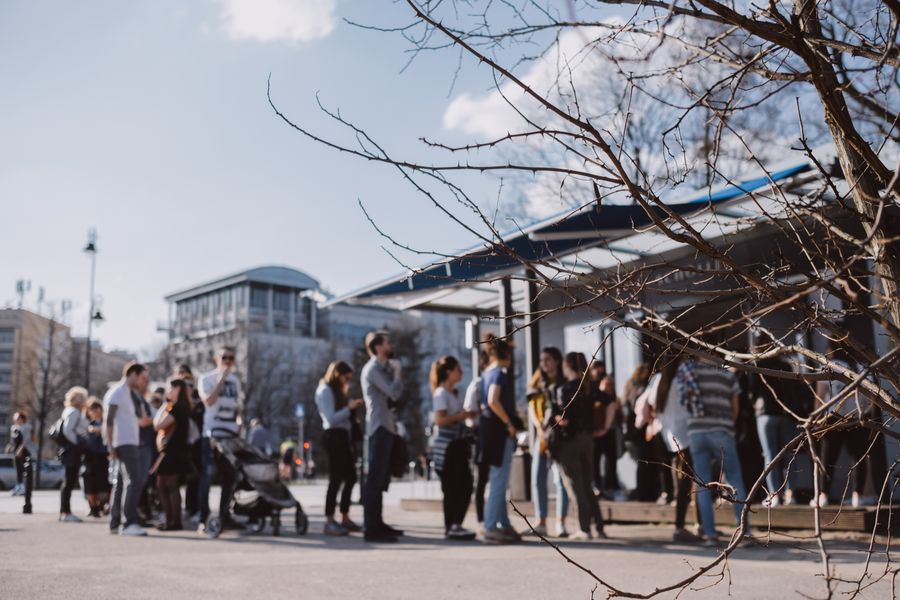
A group of adults queue outdoors near modern buildings, a bare tree in focus.
Photograph by freestocks.org via Pexels
Editorial note. Independent reporting and analysis. Nothing here is sponsored or paid for. How we work.

Busy and full are different states

There is an intuition that a service which is busy but keeping up should have no queue, since the work arriving matches the work being done. It’s a reasonable intuition and it is wrong, because arrivals do not come at a steady rate and transactions do not take a uniform time.

Even where the totals balance perfectly over a day, the moments do not. Three people arrive within a minute, then nobody for four. One transaction takes twice as long as the next two combined. Each of these produces a short queue, and once a queue exists it can only be worked off during a gap. Remove the gaps and it never clears.

Spare capacity is what absorbs a queue

A service that is occupied for, say, seven-tenths of the time has three-tenths available for catching up, and small pile-ups drain quickly. As occupancy climbs, the recovery time shrinks, and the queue left over from one busy moment is still there when the next one arrives.

This is why the relationship between load and waiting is not a straight line. Waiting increases slowly across the comfortable range and then climbs steeply as the last portion of capacity is consumed, so a service can go from acceptable to visibly failing on the back of a small increase in demand. Nothing changed about how quickly anybody works. The buffer that used to absorb the variation simply ran out.

Which is why nobody is meant to be busy all the time

A counter operation planned so that every server is occupied every minute would look maximally efficient on paper and produce enormous queues in practice. Planners therefore target an occupancy comfortably below full, and the apparently idle time is not waste. It is the mechanism that keeps waiting bounded.

The same reasoning applies to the pauses you can see. A member of staff standing free at a counter is capacity ready to absorb the next arrival, and pulling that person away to do something else is exactly what makes the queue behind them start to grow. It’s a genuinely counter-intuitive piece of arithmetic, and it is why observed idleness is a poor measure of whether a service is well run.

Variation matters as much as volume

Two services can handle identical numbers of people and behave completely differently, because waiting depends on how uneven the work is as well as how much of it there is. A queue of predictable five-minute transactions runs smoothly at a level of occupancy that would collapse a queue where most take two minutes and a few take half an hour.

That is the real argument for separating transaction types, booking the complicated ones and standardising what happens at a counter. Every reduction in unevenness buys the same benefit as adding capacity, and it is usually cheaper. It also explains why an operation can improve waiting times noticeably without hiring anybody, simply by moving the long tail of unusual cases somewhere else.

Extra capacity helps most exactly where it is hardest to justify

The awkward consequence for anyone running a service is that the value of one more server depends on where you already are on the curve. Adding a position to a lightly loaded operation changes very little. Adding one to a service near its limit can transform the waiting time, because it restores the recovery gaps.

This is difficult to argue for with numbers alone, since the cost is visible and continuous while the benefit is intermittent and shows up as something that did not happen. It is also why services under sustained pressure often look like they are failing suddenly rather than gradually. They spent a long time on the flat part of the curve and then reached the bend.

What this predicts about a real queue

It predicts that the worst waits cluster where demand is high and capacity fixed, which is usually a known period rather than a random one, and that arriving outside those windows produces a disproportionately better result than the difference in numbers would suggest.

It also predicts that a queue which is not moving is not necessarily a queue where nothing is happening. A service at its limit still completes work at full rate; it simply has nothing left over to shorten the line with. And it explains a small kindness worth extending to anybody working in one, which is that the length of the queue behind you is very rarely a fact about the speed of the person in front of it.

Common questions

Why does the wait get so much worse at peak times?

Because waiting rises steeply once spare capacity is consumed, so a modest increase in arrivals at a service already near its limit produces a disproportionate increase in queueing. The same increase during a quiet period would be barely noticeable.

Is a member of staff standing idle a sign of poor management?

Usually the opposite. Some unoccupied time is what allows a queue to be worked off after a busy moment, and an operation planned with none of it will queue continuously. Idle time is a design feature more often than it is a failure of supervision.

Why do some queues collapse without anything obvious changing?

Because the relationship between load and waiting is non-linear. A service can operate acceptably for months and then tip, with the visible change in demand being small compared with the change in waiting time it produced.

Queues & Waitingqueuescapacitywaitingprocess
Zoya Rahman
Consumer editor, What Nobody Explains

Zoya has written about behind the counter, paperwork, queues & waiting for most of the last decade and thinks most subjects are more interesting once you know how they work.