Skip to content
The part of the process nobody writes down
What Nobody ExplainsThe part of the process nobody writes down

Queues & Waiting

How order is kept where there is no line to stand in

Counters without a physical queue rely on a shared memory of arrival order, and that memory works surprisingly well until it is asked to do too much.

By Tanmay Ghosh3 min read

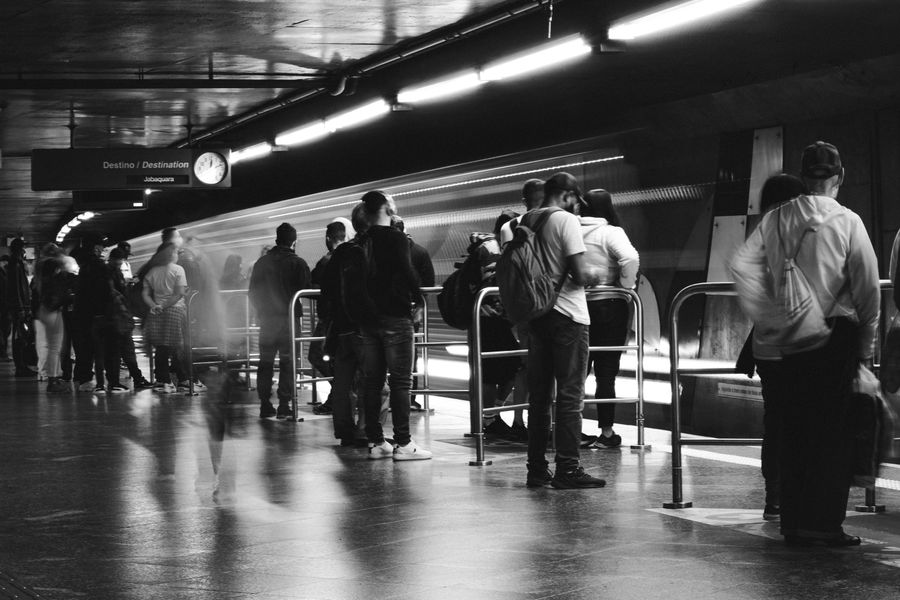
Monochrome photo of commuters on a São Paulo subway platform, capturing urban life.
Photograph by DANIEL QUEIROZ via Pexels
Editorial note. Independent reporting and analysis. Nothing here is sponsored or paid for. How we work.

A crowd that knows its own order

Plenty of counters produce no line at all. People gather in a loose group, sit down, drift between the shelves, and yet the service still proceeds in roughly the order everybody arrived. There is no rope, no ticket and no register. The ordering exists entirely in the heads of the people present.

It works through a modest and reliable piece of observation: on arriving, you note who is already there, and that set of faces is your queue position. You do not need to know the whole order. You only need to know who is ahead of you, and everybody holding that one fact produces a consistent sequence for the group as a whole.

The mechanism is a personal list, not a shared one

This distributed arrangement has properties a physical line does not. It survives people moving around, sitting down, stepping outside and coming back, because position is attached to a memory rather than to a spot on the floor. It also frees everybody from standing, which is why it is the norm wherever people wait for more than a few minutes.

Its weakness is equally structural. Nobody holds the complete list, so nobody can arbitrate. When two people believe they arrived before each other, there is no authority to consult, and the resolution has to be social. Fortunately the stakes are low and most people yield rather than argue, which is precisely why the system survives its own lack of enforcement.

Arrival has to be witnessed to count

The whole arrangement depends on your arrival being noticed. Coming in quietly and standing where nobody sees you is a genuine failure of the mechanism, not a discourtesy by anybody else, and it is the source of most disputes in unqueued spaces.

Which is why regular users of these settings do something small and deliberate on arrival: catching an eye, a nod towards whoever appears to be last, or the direct question about who is at the end. That question is doing real work. It registers you in somebody else’s list, and one other person knowing you are there is usually enough for the group to reconstruct the order later.

Servers keep their own version, and it does not always match

Behind the counter, staff are running a parallel version of the same memory, and theirs is compiled from different information. They may be tracking who has already been spoken to, who is waiting on something, and who has just come back for the second time, none of which is visible to the people waiting.

That mismatch is where the honest confusion lives. Somebody served ahead of you may be resuming an interaction rather than starting one, or may have been asked to wait while a document was fetched. From the room it looks like the order broke; from the counter it is a return to a conversation already in progress. It is worth a moment of doubt before concluding that a sequence has failed.

The threshold at which the informal system gives way

Distributed memory scales badly. It holds well for a group small enough to observe at a glance and degrades as the space fills, as people turn over quickly, or as the room becomes large enough that arrivals cannot see one another. Add several counters offering different services and it collapses, because now the question is not only who arrived first but who is waiting for what.

This is exactly the point at which organisations introduce tickets. A numbering system replaces the shared memory with an external record, at the cost of tying everybody to a slip of paper and removing the flexibility that made the informal version pleasant. Most places adopt it later than an operations planner would, because the informal version is genuinely better right up until the moment it stops working.

Behaving well in an unqueued space

The two useful habits are announcing yourself on arrival and identifying the person you are behind. Both take seconds and both make you a recorded item in the group’s memory rather than an unobserved one.

And if you are away when your turn comes, the convention is generous but limited: a brief absence is usually held, a long one is not, and the person who returns to find themselves passed over has very little standing to object. That is not harshness. A system running on the attention of strangers can only hold what those strangers can reasonably be expected to keep track of, and it works as well as it does because most people ask nothing more of it than that.

Common questions

What is the safest thing to do on arriving somewhere with no queue?

Establish who is last and make sure at least one person registers that you have arrived. A short question is more reliable than observation alone, because it puts your arrival into somebody else’s memory rather than only your own.

Is it acceptable to leave and come back?

For a short absence, generally yes, and the convention holds better if you tell somebody near you. Over a longer absence the group can no longer be expected to hold your place, particularly if the people who saw you arrive have themselves been served and left.

Why do some places use tickets when a small crowd manages fine without?

Because the informal system degrades sharply once the room is too large or too busy for arrivals to observe each other, and because several counters offering different services make arrival order insufficient on its own. Tickets are introduced at the point where shared memory can no longer be relied on.

Queues & Waitingqueuesconventionorderprocess
Tanmay Ghosh
Editor, What Nobody Explains

Tanmay has written about behind the counter, paperwork, queues & waiting for most of the last decade and is happiest when a piece answers the question completely.