Skip to content
The part of the process nobody writes down
What Nobody ExplainsThe part of the process nobody writes down

Queues & Waiting

The express lane exists because service times are wildly uneven

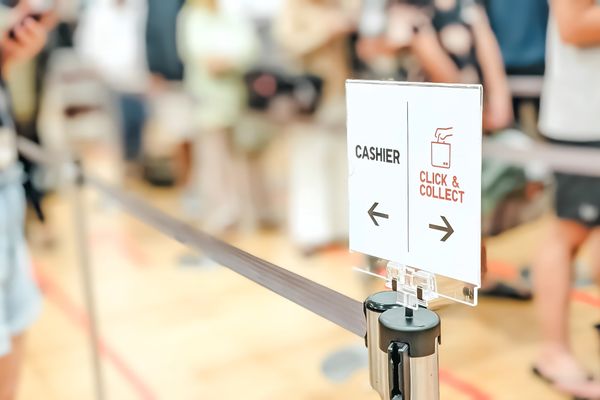
Sorting people by how long their transaction takes protects the short ones from the long ones, and the threshold is chosen more carefully than it looks.

By Nikhil Bose3 min read

People descending stairs in a subway station with modern lighting and advertisements.
Photograph by El gringo photo via Pexels
Editorial note. Independent reporting and analysis. Nothing here is sponsored or paid for. How we work.

One long transaction taxes everybody behind it

In a single line, the wait you experience is the sum of everything in front of you, so a transaction that takes twenty minutes imposes twenty minutes on each of the fifteen people behind it. The cost of a long transaction is not the twenty minutes. It is the twenty minutes multiplied by the length of the queue.

That arithmetic is the entire case for sorting. If the distribution of service times were narrow — everybody taking four or five minutes — sorting would achieve almost nothing. It is the spread that creates the opportunity, and in most counter services the spread is enormous, with a large majority of quick transactions and a small tail of very long ones.

Serving short items first reduces total waiting

A well-established result in scheduling is that, for a fixed set of jobs, dealing with the shortest first minimises the average time spent waiting across the whole set. Intuitively, a short job placed ahead of a long one delays it slightly, while the same short job placed behind is delayed a great deal.

Express lanes are an approximation of this using information the operator can actually observe. Nobody knows how long each transaction will take, but a proxy — number of items, type of request, whether documents are involved — separates the fast from the slow well enough to capture most of the benefit. It’s a rule of thumb standing in for a calculation that cannot be performed at the door.

The threshold is a compromise between two failures

Set the limit too low and hardly anybody qualifies, so the express lane sits underused while the main queue grows. Set it too high and everybody qualifies, at which point the express lane is simply a second ordinary queue and the sorting has achieved nothing.

The number chosen usually sits near a natural break in the local distribution, which is why the threshold varies between operations that look similar and why it gets adjusted over time. It also has to be checkable at a glance, since a rule requiring anybody to measure or count carefully at the entrance costs more time than it saves.

The gain is not shared equally, and that is the trade

Sorting improves average waiting across everyone, and it does so by improving matters considerably for the many with short transactions while making things slightly worse for the few with long ones, who now wait behind a queue from which the fast movers have been removed.

Whether that is fair is a legitimate question rather than a settled one. The usual defence is that a long transaction was always going to take a long time, so the proportional impact on that person is smaller, and that the alternative distributes a large delay across a much bigger group. It is a defensible trade rather than an obviously correct one, and it is worth being honest that somebody is paying for it.

Enforcement is social, which is why the limit needs to be simple

Almost no express lane is policed rigorously. Staff have limited appetite for turning people away over a marginal case, and the queue behind does the rest through visible impatience. That works only while the rule is simple enough for everybody to apply the same judgement without argument.

It is also why the rules are expressed in whatever unit is easiest to see rather than the unit that actually predicts duration. Items, not complexity. One request, not one problem. The proxy is crude on purpose, because a precise rule that requires interpretation at the entrance produces disputes, and disputes at the front of a queue are more expensive than the misallocation they were meant to prevent.

Where sorting quietly fails

The proxy breaks down whenever the visible measure stops predicting time. A small number of items requiring an unusual check takes far longer than a large number of ordinary ones, and any transaction that needs a second person, a document or an override escapes the sorting entirely.

Which explains the express lane that is somehow slower than the main queue. It hasn’t been mismanaged; it has collected a run of transactions that satisfied the rule while breaking the assumption behind it. Over a day the sorting still pays for itself. Over any ten-minute window it can look exactly like a mistake, and there is not much anybody standing in it can do beyond recognising what has happened.

Common questions

Does an express lane make everyone else wait longer?

It makes the average wait shorter overall while shifting some delay onto the longest transactions, which lose the benefit of quick customers moving through ahead of them. The net effect on total waiting is positive; the distribution of it is deliberately uneven.

Why is the limit set where it is?

It is usually placed near a natural break in the local mix of transactions, high enough that the lane stays busy and low enough that it does not become a second general queue. It also has to be verifiable at a glance, which rules out more accurate but slower measures.

Why is the express lane sometimes the slowest one?

Because the eligibility rule is a proxy for duration rather than a measure of it. A short-looking transaction that needs an unusual check or an authorisation can take longer than several ordinary ones, and a few of those in succession will make the fast lane the slow lane for a while.

Queues & Waitingqueuessortingwaitingprocess
Nikhil Bose
Reporter, What Nobody Explains

Nikhil writes the explanatory pieces on behind the counter, paperwork, queues & waiting and would rather show the working than assert the conclusion.